This work is centered on rematriation, which means to return to the land. For us, it is returning the land to herself. Rematriation is different from repatriation, which often means to return to people. With regard to reparations work with Indigenous communities, rematriation addresses this country’s violence toward Native folks, perpetuated through land-theft and through its cultural and political institutions perpetuating genocide and culture and knowledge destruction. Many Indigenous communities’ original and continuing structures of leadership feature women and non-male members, and their relationship to the land is an important part of their role as creators of human life and of community. Rematriation not only returns the land to Indigenous communities and to herself. It also acknowledges the harm done through the patriarchal power structures behind settler-colonialism to begin with. Rematriation, therefore, means the return of Indigenous knowledge and systems of community leadership to the land as well.
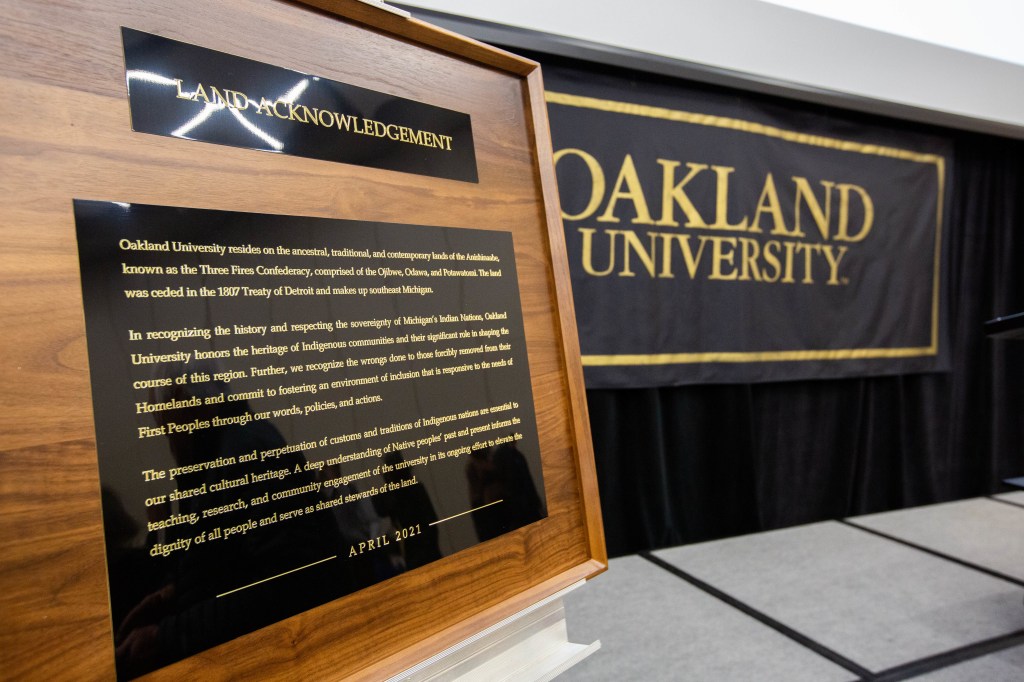
In preparation for a ceremony to mark the adoption of the Land Acknowledgement, we met with Interim Associate Provost Amy Banes-Berceli to organize a program. Over the course of that discussion we focused on the ways the university could make a step forward in committing to the work of the Acknowledgement and keeping it an active verb. We discussed what gifts the university could give to the Indigenous community or actions it could take as a sign of their commitment to a new future together. Many ideas were floated, but in a moment that all ideas inevitably led to, we asked for land — the rematriation of land. It was the only true way to start this relationship in the spirit that we had painstakingly crafted into the Acknowledgement.
With the help of Keith Hahn from the Office of Legal Affairs, who worked with Amy, an acre of land was secured as a Native American Heritage Site. This was a process that constellated a lot of factors. From the history of the land as told through Michigan’s Constitution and the 1807 Treaty of Detroit, to the property history of the campus itself, to the university’s future development plans, to approvals needed from several offices – the site was finally designated a Heritage Site in order to codify the space’s identity as a place reserved for Native American and Indigenous education, ceremony, and cultural practice. Situated adjacent to two parking lots and sloping into the campus’s Western Biological Preserve, the site is away from the main bustle of campus traffic but convenient to it. And its horizon is lush because the preserve circles it like an embrace around most of its length (the site is now linked on the campus digital map). This is not the only way that settler-colonial institutions can give land back, but it is a way, and one we are learning about on each slow step of this journey.

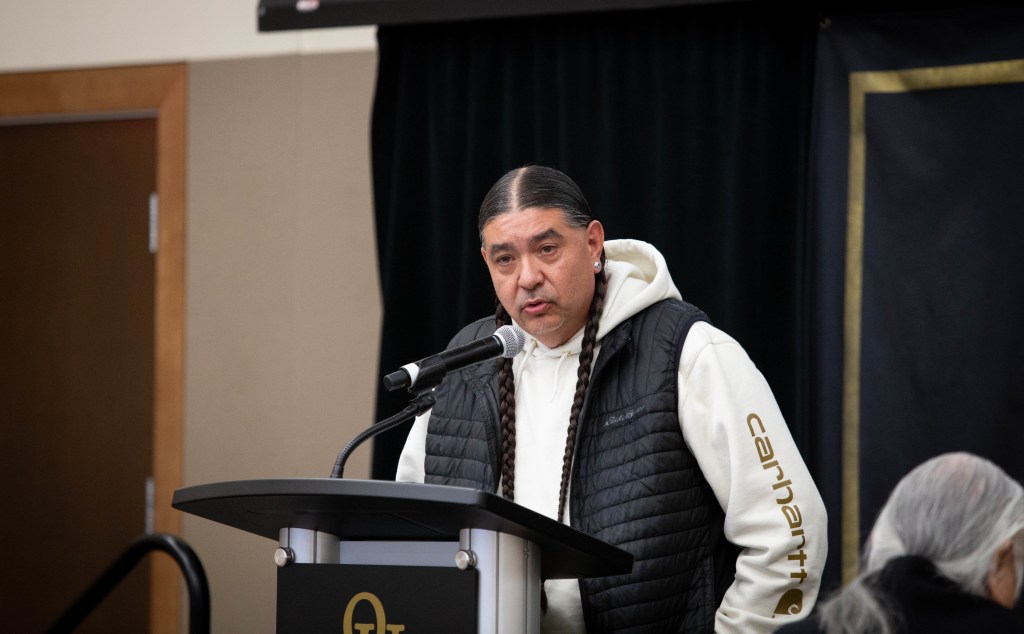

The ceremony to unveil the Acknowledgement was held on April 1, 2022 and led by Jerry and Wayne Cleland (Black River, Swan Creek Ojibwe). Joe Reilly (Cherokee) provided music for the occasion. And it was during this event that Gidinawemaaganinaanig: Endazhigiyang ᑭᑎᓇᐧᐁᒫᑲᓂᓈᓂᒃ ᐁᓐᑕᔑᑭᔭᓐᒃ was also unveiled.
A map was handed out to all attendees that included its location and its name in Anishinaabemowin syllabics. It was an interesting moment in hindsight because just before the event we overheard a conversation between a couple of women who didn’t attend but who were criticizing the event for being yet another empty gesture. We were glad that members of our campus community understood the problems of land acknowledgments. It’s always good to find accountability for work being done towards “diversity, equity, and inclusion.” Hopefully they’ve found out about the land and the plans underway for its reunion with its original stewards.
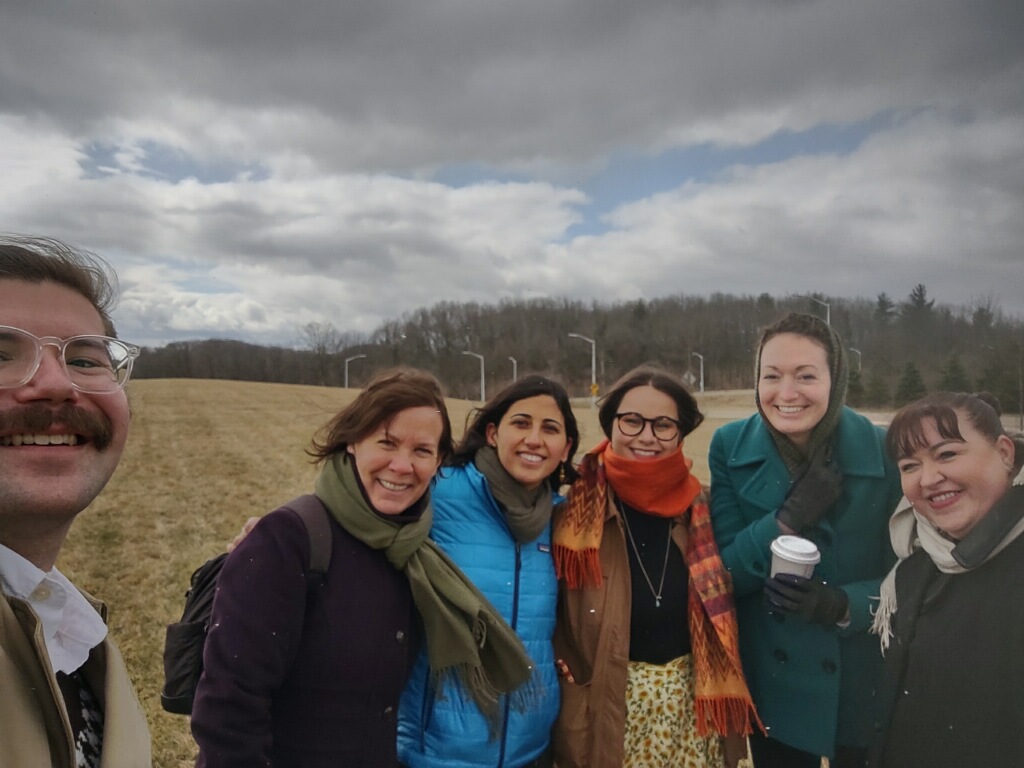
“Gidinawemaaganinaanig: Endazhigiyang” means “All Our Relations: The Place Where We All Grow” in Anishinaabemowin. Named through a process that began with the Land’s original stewards providing ideas, suggestions, and syllabics, this name returns Anishinaabemowin to the Land, names her in a descriptive practice traditional to the Anishinaabe, and outlines our intentions and hope for our relationship with her.
Institutions of higher education in this country are wholly unprepared to enter into relationships with Indigenous communities by the use of their own practices.
Our work thus far has been solely guided by one precedent (we aren’t aware of other campuses in North America that have returned land to any degree to Indigenous people) – and that is, to return again and again to the reunion of this space with its Native caretakers. This entails the broader, overarching institutional work of ensuring that Oakland University does not cause harm in its fledgling relationship with our Indigenous community. Institutions of higher education in this country are wholly unprepared to enter into relationships with Indigenous communities by the use of their own practices. In order to guide, advise, and protect the Land and our responsibilities to our Indigenous community, we established the Native American Advisory Committee (NAAC). For now it consists of the volunteer labor of campus-affiliated individuals, half of whom are Native or Indigenous peoples, but with the plan of bringing on additional representatives from our immediate Indigenous communities. Before non campus-affiliated Indigenous individuals join the Committee we must first complete an education of the Committee and any campus individuals/offices/departments with whom the Committee will work directly and raise funds to financially compensate our community representatives for their knowledge and time. For now, the NAAC will work to ensure that the Land has a voice, and we will guide plans, events, and initiatives on campus related to Native American and Indigenous peoples so that they are carried out respectfully and responsibly. We will serve as liaisons between the institution and the Indigenous community, keeping the voice, values, and needs of the Indigenous community as the utmost priority.
 Gidinawemaaganinaanig: Endazhigiyang