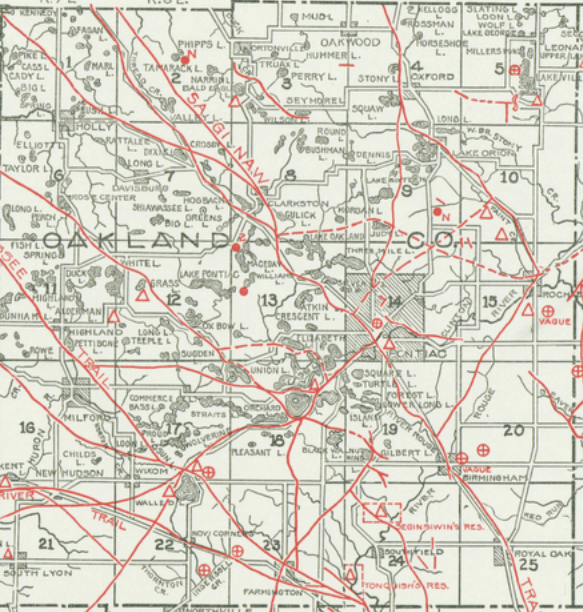
We call this land that abuts Oakland University’s Biological Preserve by her name in Anishinaabemowin: Gidinawemaaganinaanig Endazhigiyang (All Our Relations: The Place Where We All Grow). We practice the syllables and feel her cadence in our mouths as a kindling of intimacy. This is how our relationship began:
Acknowledging the land is a common practice among Native and Indigenous folks. When we introduce ourselves, we acknowledge our traditional lands, the lands that have raised us and supported our lives. When we gather in new places, we acknowledge that we do so with respect to and from the gift of the land that holds us. The practice of giving an official Land Acknowledgement has now been adopted by settler colonial institutions as a way of citing the stewards whose displacement allows those institutions to exist on land today. But many Indigenous folks view the practice of Land Acknowledgements by settler colonial institutions (higher ed or otherwise) as empty gestures. Our misgivings about writing a land acknowledgment aligned with Mi’kmaw scholar Robbie Richardson’s, who articulates the problem by calling into focus the emptiness of Land Acknowledgements that become shallow statements of positionality:
my misgivings largely stem from the absence of Indigenous people in their crafting or delivery: who is this acknowledgment for? Who will hear it? And what gives the speaker the right to evoke a relationship with people about whom they know very little in the present tense? Further, to what extent do these acknowledgments perform the very act they are intending to interrupt: the relegation of both colonialism and Indigenous sovereignty to the past, and the assumption that healing can begin based on a supposedly new relationship without any real implications for the speaker?
Robbie Richardson, Some Observations on “Decolonizing” the University, in “Antiracism in the Contemporary University,” The Los Angeles Review of Books. July 26, 2021
But then in 2019 a Native student at Oakland University (OU), Tara Maudrie (Sault Ste. Marie Tribe of Chippewa Indians), wrote a Land Acknowledgement for OU in an Honors College class led by Professor and Dean of the College, Graeme Harper. At the time Maudrie was a student in the Pre-Health Professionals Program in the School of Health Sciences and the I-LEAD Program Assistant for American Indian Health and Family Services in Detroit. Maudrie’s Land Acknowledgement was posted on the AIHFS’s blog, and with permission, we used it to begin the process of developing one for Oakland. We wanted to, in this work, address the misgivings that Richardson points to as essential questions to grapple with, and use them as calls to do this work in a new and different way. We began with a commitment to consult and seek guidance on our drafts from the Indigenous community of Michigan and its original stewards: the Anishinaabe. With special support from Shiloh Maples (Little River Band of Odawa; Ojibwe) and Catherine Hollowell (Sault Ste. Marie Tribe of Chippewa Indians), who wrote letters of support, the ad hoc Land Acknowledgement Committee listened to community input, and crafted a Land Acknowledgement.
Gathered around tables, in GoogleDocs, and filtering through email, 3 faculty members: Megan Peiser (Choctaw Nation of Oklahoma), Department of English; Andrea Knutson, Department of English; and Mozhgon Rajaee, Department of Public and Environmental Wellness; and one student, Ashleigh Dubie (Cherokee), English STEP major, wrote the spirit of a hoped for Indigenous future into two paragraphs. Though constantly pressed to hurry up, write in a certain way, and serve the timelines, expectations, and traditions of the University calendar and hierarchy, we resisted. We returned again and again to the spirit of this work that centered Indigenous knowing and values. We returned again and again to the words of Shiloh Maples: this work is done by the sacred inch. We wanted to do this right, not quickly. We let the path forward unfold before us on a different timeline—one dictated by the Native community’s needs.
Our goal was to craft a Land Acknowledgement that was not a publicity stunt of performative allyship. Carefully in our writing we cited the original stewards, remembered how and why this land is missing their presence, and committed to a shared obligation where Oakland University would for the first time take up its responsibilities to this land in the spirit and honor that the Anishinaabe have shown us. This meant we were going to have to figure out how to do this as we were doing it because we had no precedent for this process. As we sought to have the Land Acknowledgement adopted officially by the university, we entered into an educational campaign up through administrative offices and departments, teaching representatives from these various sites of institutional power about the history of treaties, removal, boarding schools, the outlawing of language, religion and culture, about land theft, tribal identities and enrollment procedures, cultural appropriation, and government policies in this country that have influenced the lives of all of North America’s Indigenous peoples. We spoke with the Office of Diversity, Equity, and Inclusion, and the DEI Council, the Faculty Diversity, Equity, and Inclusion Committee, the Provost’s office, and Deans of the College of Arts and Sciences and the Honors College. We faced obstacles when the University’s Office of Legal Affairs expressed concern that this statement might in some way trespass upon the University’s founder’s legacy or fluster current donors. But we also found champions in various positions, including Dr. Cynthia Miree-Coppin, Joi Cunningham, Provost Britt Rios-Ellis, and Prof. Jason Wasserman, who took up the Land Acknowledgment in its final approval stages and swiftly brought it to the Faculty Senate for a vote. It was adopted with overwhelming approval from the Senate on Feb. 18, 2021, and with this support in hand, the Land Acknowledgement was presented to and accepted by the Board of Trustees on April 8, 2021 and announced to the campus community on May 5, 2021:
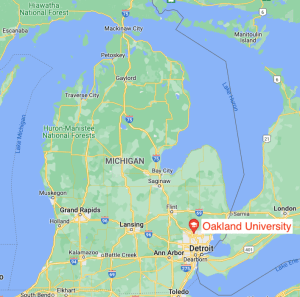
Oakland University resides on the ancestral, traditional, and contemporary lands of the Anishinaabe, known as the Three Fires Confederacy, comprised of the Ojibwe, Odawa, and Potawatomi. The land was ceded in the 1807 Treaty of Detroit and makes up southeast Michigan.
Oakland University’s Land Acknowledgement
In recognizing the history and respecting the sovereignty of Michigan’s Indian Nations, Oakland University honors the heritage of Indigenous communities and their significant role in shaping the course of this region. Further, we recognize the wrongs done to those forcibly removed from their Homelands and commit to fostering an environment of inclusion that is responsive to the needs of First Peoples through our words, policies, and actions.
The preservation and perpetuation of customs and traditions of Indigenous nations are essential to our shared cultural heritage. A deep understanding of Native peoples’ past and present informs the teaching, research, and community engagement of the university in its ongoing effort to elevate the dignity of all people and serve as shared stewards of the land.


One thought on “Acknowledging the Land: Our First Step”